
I am always excited to work with Louvre Abu Dhabi and explore international exhibitions that bring international art and global stories into one shared space. Every exhibition offers a new way of seeing the world but some exhibitions stay with you longer than others. This time Louvre Abu Dhabi opened its doors for Pablo Picassoand the experience felt both powerful and deeply personal.
The exhibition titled “Picasso, The Figure”brings together around 130 artworks focusing on one subject that followed Picasso throughout his entire life, the human figure. Walking through the exhibition feels like walking through Picasso’s thoughts, emotions, relationships and constant experimentation. It is not only about how people look but about how people feel, suffer, love and exist.
Picassolife in brief
Pablo Picasso was born in 1881 in Malaga, Spain. His artistic journey began early guided by his father who was an art teacher. Picasso received formal education in art but he quickly moved beyond traditional academic methods. He was never satisfied with repeating the past. He wanted to change it.
His early works were shaped by the Blue Period, a time when his paintings reflected sadness, isolation and emotional struggle. The figures from this period often appear thin, quiet and lost, painted in shades of blue and grey. This phase was followed by the Rose Periodwhere warmer colours entered his work and themes of affection, performers and human connection became more visible.
Picasso later changed modern art forever through Cubism, developed alongside Georges Braque. Figures were broken into geometric shapes, faces were shown from multiple angles and reality was reconstructed on canvas. Picasso continued evolving throughout his long life, moving freely between styles, materials and techniques. Yet no matter how abstract his work became, the human figure always remained at the centre. Picasso continued creating until his death in 1973, leaving behind a legacy that still influences artists today.
An exhibition shaped by collaboration
“Picasso, The Figure” at Louvre Abu Dhabi was curated by Cecile Debray President of the Muse national Picasso in Paris and Aisha Al Ahmadi Associate Curator at Louvre Abu Dhabi.
The exhibition was created in partnership with the Muse national Picasso in Paris allowing important works to travel and be experienced in a new cultural and geographical context. This collaboration highlights the museum role in creating dialogue between cultures and generations.
Six sections inspired by Greek mythology
The exhibition is divided into six sectionsinspired by characters and stories from Greek mythology. These myths mirror Picasso’s artistic questions about creation, transformation, desire, violence and survival.
The six sections are:
Orion
Pygmalion
The Minotaur
Deucalion and Pyrrha
Guernica
Picasso’s Canon
Each section explores how myth and the human figure intersect. The body becomes a symbol, sometimes heroic, sometimes fragile, sometimes broken. Through mythology Picasso connects ancient stories to modern emotions.
Paintings and artworks in focus
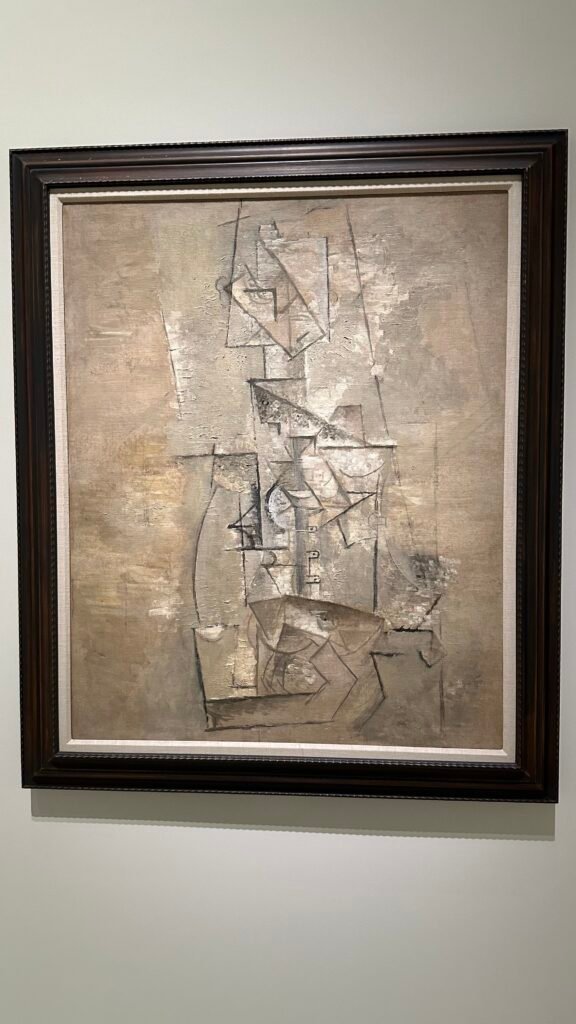
Woman with a Mandolin
This painting is one of the strongest examples of Picasso cubist language. At first glance the figure seems fragmented and abstract. The woman and the mandolin are constructed from overlapping shapes, curves and planes. As you spend more time with the painting, the figure slowly becomes clearer.
Picasso does not present the woman as a fixed image. Instead he shows multiple viewpoints at once. The mandolin is not just an object she holds but part of her form. Music, body and space merge together. This painting challenges the viewer to actively engage to rebuild the figure mentally and to accept that reality can exist in many forms at the same time.
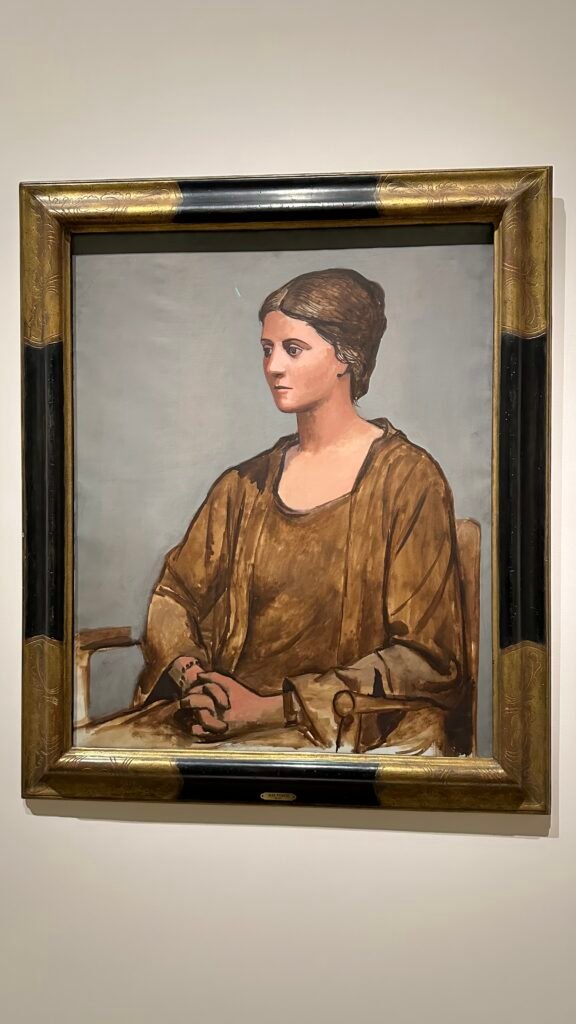
Portrait of a Seated Woman (Olga)
Olga Picasso’s wife appears seated with grace and formality. Her posture is controlled and her expression feels distant. The painting communicates emotional complexity through stillness rather than drama.
This portrait reflects a period in Picasso’s life where personal relationships influenced his work deeply. The structured composition contrasts with the emotional tension beneath the surface. Olga is present yet reserved. The painting speaks quietly but its emotional weight grows the longer you look at it.
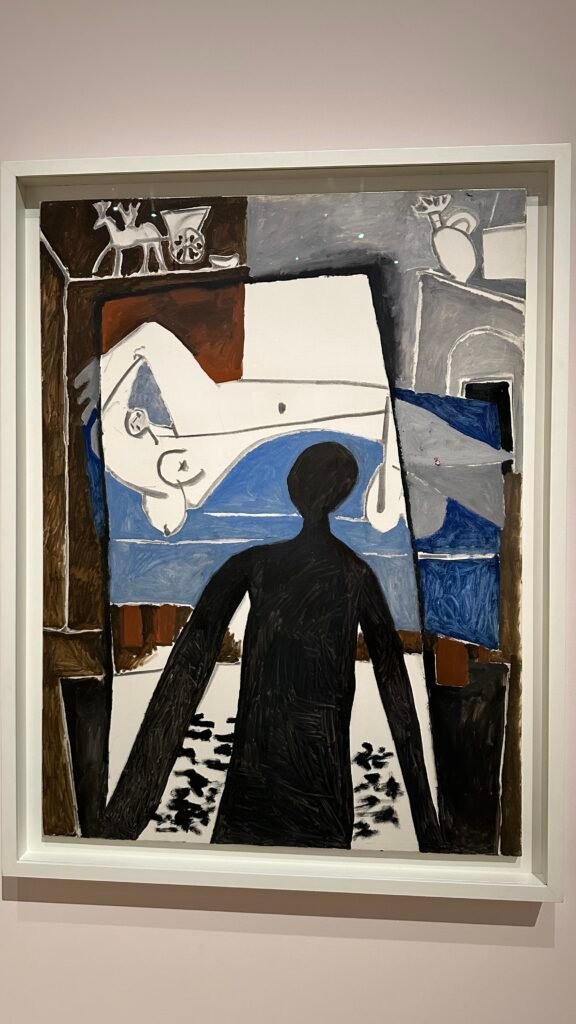
The Shadow
In The Shadow Picasso introduces a psychological dimension to the human figure. The shadow is not simply a result of light. It feels like a second presence almost a reflection of the inner self.
The figure and the shadow exist together creating tension between what is visible and what is hidden. The painting suggests ideas of memory, identity and the unseen aspects of human experience. Through minimal form and contrast Picasso creates a deeply emotional atmosphere.
Guernica and the language of suffering
The Guernica section forms the emotional core of the exhibition. Guernica represents Picasso’s response to war, violence and the destruction of innocent lives. Even without the original painting present its influence dominates the space.
The fragmented bodies, distorted faces and sharp lines echo the pain and chaos of conflict. Guernica is not a historical document. It is a universal expression of human suffering.
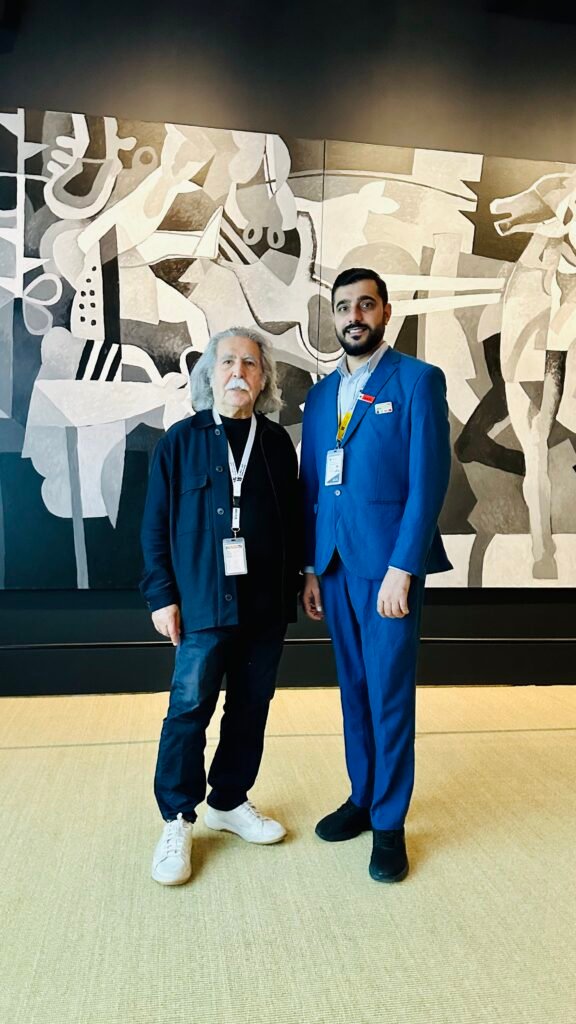
Dia Al Azzawi, Elegy to My Trapped City(2011)
This dialogue continues through Dia Al-Azzawi’s powerful painting Elegy to My Trapped City. Deeply influenced by Picasso’s Guernicathe work adapts a visual language of fragmentation and emotional intensity to speak about modern conflict and human suffering. The painting was created in response to the attacks on Baghdad, Al-Azzawi’s beloved city and reflects his deep personal pain and connection to the place.
The figures appear trapped within the composition, surrounded by chaos, broken forms and sharp lines. There is a strong sense of loss, displacement and resilience running through the work. For me it was a true pleasure to meet Dia Al-Azzawi in person and capture a moment standing in front of his painting. That moment added another layer of meaning, turning the artwork from an image into a shared human experience. Displayed alongside Picasso’s influence the painting shows how one artwork can continue to inspire new voices across cultures and across time.
Picasso Canon
Towards the end of the exhibition, the section dedicated to Picasso’s Canon explains how Picasso gradually developed his own visual system. Over time he moved away from classical representation and created a personal language of form, line and proportion. Mythological figures, historical references and human bodies were no longer copied from tradition. Instead, Picasso reshaped them through his own vision.
In this canon, mythology became flexible. Heroes and symbolic figures were transformed into modern bodies, distorted faces and powerful gestures. Picasso did not aim for beauty or accuracy. He aimed for expression. This approach influenced generations of artists who followed, many of whom adopted elements of Picasso’s language, fragmented bodies, symbolic forms and emotional intensity making the Picasso Canon a foundation of modern artistic thinking.
Within this context, the exhibition turns toward something more personal. One of the most touching moments is encountering Picasso’s painting of Paloma. Unlike the mythological figures and abstract forms, this work feels intimate and direct. The figure is not a symbol or a story from the past. It is a father looking at his child.
The painting of Paloma carries tenderness, curiosity and presence. It reminds us that behind the revolutionary artist was a human being, shaped by family and personal relationships. This moment brings the exhibition back to the human scale, where legacy is not only artistic but emotional.
“Picasso, The Figure” is not simply an exhibition. It is a reflection on what it means to be human. Through mythology, form and emotion Picasso reminds us that the human figure is never fixed. It changes, breaks, reforms and evolves.
Once again Louvre Abu Dhabi succeeds in presenting a global artistic voice within a shared cultural space. Picasso’s figures continue to speak and through this exhibition you are invited to listen, reflect and engage.